Furniture history and conservation
Reading the Craftsmanship of Antique Metal Bedroom Furniture
An old bedstead is more than a framework for a mattress. Its joints, fasteners, finials and finish record choices made by designers and workshops—and changes made by every person who has owned it since. Learning to read those details can help distinguish an antique from a later interpretation, and can guide sensible care without erasing the evidence that gives a piece its character.
Published 11 October 2026
There is a particular kind of quiet in a room containing an old metal bed. Even when it is empty, it suggests bodies, habits and domestic rituals: a book left open at the bedside, a quilt folded back, the small daily business of getting in and out. The bed itself may look straightforward—upright posts, rails, a pair of head and foot ends—but close inspection turns that apparent simplicity into a record of manufacture.
Antique metal bedroom furniture is often described by its most visible material: brass, iron or, in some cases, a combination of metals and wood. Yet the metal alone cannot tell the whole story. How the parts meet, how the rails lock into the posts, how decoration is formed, and how the surface has aged all matter. These are not merely clues to beauty. They help establish whether a bed is stable, whether its components belong together, and whether an intervention is likely to preserve or diminish it.
Brass beds, especially, occupy a familiar place in the popular imagination. Their polished rails and globular finials have become shorthand for Victorian and Edwardian bedrooms. But the category is broader than a single fashionable silhouette, and “brass” is sometimes used loosely. A careful assessment begins with observation rather than a verdict. Look first; interpret second; reach for polish, tools or replacement parts only after the structure has been understood.
A bedstead as a piece of engineering
A bed has to carry weight repeatedly, distribute it across a frame and remain quiet while doing so. Decorative furniture can afford to be delicate in places; a bed cannot. Its design therefore balances appearance with practical construction. Rails must connect securely to the end frames, the mattress support must sit at a consistent height, and the posts must resist movement in more than one direction.
On many metal bedsteads, the long side rails are detachable. This made the furniture easier to transport through narrow doors and staircases, and allowed a bed to be dismantled when a household moved. The rail ends may engage with slots, hooks, lugs or other fittings at the posts. Details vary by maker and period, so a fitting should not be judged against a single assumed standard. What matters is whether the corresponding parts are complete, compatible and secure.
Examine a joint without forcing it. Look for movement where the rail meets the post, gaps that widen under light pressure, fresh scratches around a fitting, or a rail that appears to have been adapted. A bed that rocks may have a simple explanation—a loose connection or uneven floor—but it may also have a worn fitting, a distorted rail or a mismatched replacement. Do not solve the problem by hammering parts together. A forceful adjustment can crack a casting, deform a slot or make a later repair harder.
At the corners, observe how the metal is shaped. A clean transition may indicate a cast, turned, forged or assembled component, but surface appearance alone rarely identifies a process with certainty. Tool marks, seams and repeated patterns can offer useful evidence, particularly when compared across several parts. An expert assessment may be necessary where attribution or material identification has significant consequences.
The rails also provide a clue to the bed’s working life. Look for bends, flattening, improvised brackets and holes that do not align with the original fittings. These may reflect repairs, adaptation to a different mattress system or the replacement of missing components. A modification is not automatically a defect in historical terms; it is part of the object’s history. The question is whether it compromises safety, and whether it can be addressed without removing sound original material.
What the details can—and cannot—date
Decorative metal beds became increasingly prominent in the nineteenth century, as new production methods and changing ideas about domestic cleanliness helped make metal bedsteads desirable. Compared with heavily upholstered or wooden structures, a metal frame could be perceived as more hygienic and easier to keep clean. Industrial production also made components and patterns available to a wider market, though quality and finish varied considerably.
Style can narrow the field, but it is not a clock. Turned posts, restrained rails, floral details, scrollwork and geometric ornament each belong to broad design vocabularies that persisted, returned or were revived. A bed with a Victorian-looking outline could be a later reproduction; an original piece might have been altered to suit a newer room. A single finial or decorative motif should never bear the weight of an entire attribution.
Consider the object as a system. Do the head and foot ends share a coherent design? Are the fittings consistent? Does the wear make sense across parts that would have been handled together? Do the dimensions and construction seem plausible for the claimed period? If a seller or family history gives a date, record it as provenance to investigate—not as proof. Old furniture often accumulates confident stories, and stories can outlast the evidence that might have confirmed them.
Manufacturing marks, labels, stamped numbers or maker’s names may be especially helpful, but they should be documented before cleaning. Record their location and appearance with written notes, and consult catalogues, trade directories, museum records or specialist literature where available. A name on a component may identify a supplier rather than the maker of the whole bed. Absence of a mark, meanwhile, proves little; many objects were never marked, and marks can be lost through wear or later refinishing.
In the United Kingdom, surviving bedsteads may have moved between regions, homes and generations. Their current location does not necessarily reveal where they were made. Regional histories, auction records and family documents can provide context, but any claim should be proportionate to its evidence. The most useful description is often a careful one: what can be seen, what seems likely, and what remains uncertain.
Finials, rails and the grammar of ornament
Finials—the ornaments at the tops of posts—are among the first features people notice. They may be spherical, faceted, urn-shaped or more elaborate, and they can make a bed read as formal, playful or severe. Their practical contribution is limited, but their condition is revealing. Check whether each finial is secure, whether the threads or fittings appear original, and whether the set is consistent in size and finish. A replacement may be perfectly functional while differing subtly from its companions.
Rails often carry decoration at a different scale. Repeated collars, rings or small cast motifs can give a frame rhythm, while the spaces between them leave the metal structure legible. Look for repetition that is regular without being mechanically identical; compare the same detail on both sides of the bed. A pattern that suddenly changes may indicate a repair or replacement. It may also reflect an intentional variation, so record rather than assume.
Ornament can tell a story about taste, but restraint is useful. A plain frame may be carefully made, and a richly decorated one may be poorly assembled. Assess the whole object: proportion, alignment, surface, construction and present stability. In the best examples, decoration does not conceal the engineering. It gives the engineering a visual cadence.
Missing ornaments can be tempting to replace. Before doing so, establish whether the piece is actually incomplete. An empty fitting might have been designed to remain open, or a cap may have been lost long ago. If a replacement is required for safe use, a reversible and well-documented solution is preferable to an imitation presented as original. Keep removed or displaced components, label them, and record where they were found.
Reading brass, iron and surface change
Brass is an alloy of copper and zinc, and its appearance can range from bright yellow-gold to a deeper, muted brown. Some bedsteads present a gleaming surface; others show a softened patina formed through age, handling and exposure. Brightness alone is not a measure of quality. A heavily polished object may have lost traces of its original finish, while a dull surface may simply need gentle cleaning—or may be intentionally left undisturbed as evidence of age.
Metal furniture may also use plated, painted or lacquered surfaces. A golden appearance does not establish that a component is solid brass. Look for changes in colour at edges, worn areas or scratches, but avoid testing with sharp tools or abrasive compounds. Such tests can damage the surface and may reveal less than they promise. Where material identification matters, consult a conservator or knowledgeable specialist.
Iron presents a different set of concerns. Rust may appear as a fine orange bloom, raised flakes or deeper loss of metal. Surface rust is not the same as structural failure, but corrosion around joints, thin sections or load-bearing connections deserves close attention. Do not assume that painting over corrosion solves it. A coating can hide continued deterioration, and removing old paint may disturb historically significant finishes or expose hazardous substances.
Inspect the surface under soft, even light. Note whether colour changes are gradual or abrupt, whether a coating is lifting, and whether the wear is concentrated where hands might naturally touch. The handrail-like upper bars, finials and exposed edges often show patterns of use. Dirt and old polish can also collect around joints and decorative recesses. These deposits should not be confused with corrosion or original finish without careful examination.
Patina is a word often used to romanticize any darkened surface. In conservation, it is more useful to describe exactly what is present: tarnish, oxidation, lacquer, paint, residue, wear or corrosion. The distinctions matter because each calls for different treatment. When in doubt, leave the surface alone until its composition and significance are better understood.
Condition before appearance
Before buying, moving or restoring an antique bed, assess condition in a deliberate order. Start with the broad structure, then examine joints and fittings, and only then turn to decoration and finish. This avoids the common mistake of being so absorbed by polished metal that a loose rail or compromised post goes unnoticed.
- Check alignment: Stand back and see whether the head and foot ends appear upright and parallel. Look for leaning posts, bowed rails or a frame that twists.
- Inspect connections: Identify how each rail attaches. Note looseness, missing fittings, improvised screws, distorted sockets or evidence that parts have been forced together.
- Look for cracks and losses: Pay particular attention to castings, thin sections, corners and areas around drilled holes. A hairline crack can be easy to overlook beneath polish or paint.
- Review the support system: Establish whether the original mattress supports are present and whether they are suitable for safe use. A historic frame may require a compatible support solution rather than an assumed modern fit.
- Document changes: Photograph repairs, replacements and marks before dismantling or cleaning. Keep notes on which components came from which position.
- Consider safe handling: Metal beds can be awkward and heavy. Secure loose parts, protect floors and use appropriate help when moving or reassembling them.
A sound inspection does not require dismantling a bed on the spot. If it is safe and appropriate to do so, a careful examination of accessible connections can be useful. But seized fittings, fragile castings or unstable frames should be left to a qualified professional. The cost of an assessment may be modest compared with the cost of a broken original component—or an injury.
Remember that “condition” is not synonymous with “value.” An intact finish may matter to a collector; stable structure may matter most to a household intending to use the bed. A restoration project can be rewarding, but it should begin with an honest account of the work required, the skills available and the object’s historical significance.
A cautious approach to restoration
Restoration is not simply the act of making an old object look new. It involves choices about what to retain, what to repair and what to replace. Each choice changes the evidence. Before cleaning, take clear photographs from all sides and close-ups of joints, marks, damage and surface variations. Keep those images with written notes and any paperwork that came with the bed.
Begin with the least intervention possible. Dry dusting with a soft brush or cloth may be enough to reveal detail. Avoid steel wool, abrasive pads, aggressive metal polish, acids and household cleaning mixtures unless a conservator has advised their use for the specific surface. These products can scratch, strip lacquer, remove plating or polish away the very evidence that helps identify the bed.
Do not apply oil or wax indiscriminately. A treatment that is suitable for one surface can leave residue on another, attract dust or interfere with a later conservation treatment. Nor should a rusty fitting automatically be soaked or scraped. Before treatment, identify whether the surface is painted, plated, lacquered, bare metal or a mixture of finishes.
Structural repairs deserve the same care. A specialist can assess whether a fitting can be repaired, whether a replacement should be fabricated, and how to keep a new part distinguishable from an original where appropriate. Reversibility is a useful principle: prefer interventions that can be understood and, if necessary, undone without further harm. Keep removed parts, label replacements, and record the date and nature of work.
If the bed is intended for regular use, safety takes precedence over display. A visually attractive frame may not be suitable for a sleeper if joints are unstable, rails are damaged or the support arrangement is inadequate. Have questionable parts assessed before use. The appeal of an antique should not depend on taking avoidable risks with it—or with the people who sleep in it.
Period furniture and the changing bedroom
Bedroom furniture is often treated as a private, quiet branch of design history. In fact, the bedstead reflects wider changes in production, health, taste and household organization. Metal frames belonged to an era in which industry could shape domestic objects at scale, while decoration helped make practical equipment feel at home in the bedroom. Their forms moved between utility and display, between the promise of cleanliness and the pleasure of ornament.
The bed also sits in conversation with the rest of a room. A brass frame can appear unexpectedly modern beside plain bedding, or emphatically historical among heavy textiles and dark wood. The surrounding furniture affects how its lines are read: a narrow bedside table can echo the verticality of posts; a broad chest can make a light metal frame feel more delicate. These relationships are not rules of period accuracy so much as ways to notice proportion and material contrast.
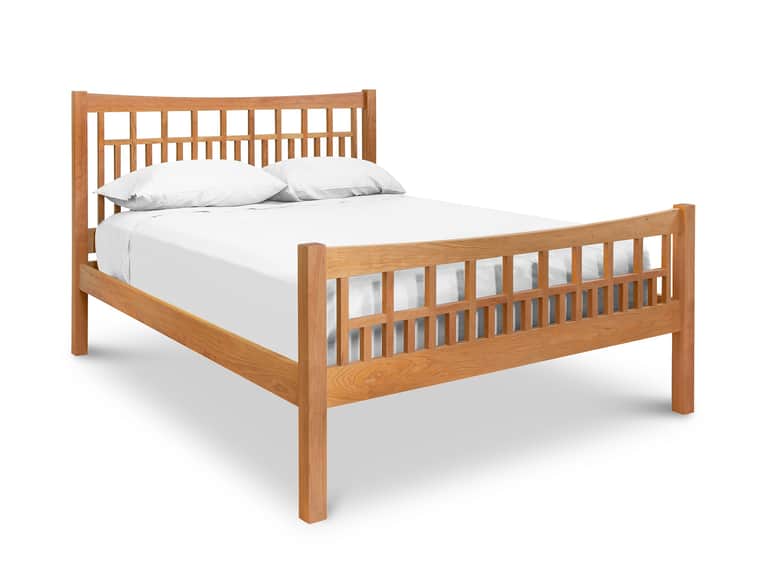
Comparing metal beds with contemporary wooden bedsteads makes the distinctions clearer. A present-day platform bed may rely on closely spaced slats and carefully selected timber, while an antique metal frame expresses its structure through rails and fittings. The Glastenbury Platform Bed, for example, is a modern solid-wood design with mission-style legs, an Arts and Crafts-influenced head and foot, and an eco-friendly oil finish. It is not an antique metal bed; rather, it offers a useful point of comparison in how visible construction and material character shape a bedroom object.
Such comparisons help keep historical study grounded. New furniture can carry forward older values—durability, legible joinery, careful proportion—without pretending to be old. Conversely, an antique need not be frozen in a period room to be worth understanding. Its past is part of its meaning, but its continued life also belongs to the story.
A practical field note for collectors and owners
When encountering a bedstead in an auction room, an inherited house or a second-hand shop, resist the urge to decide what it is from across the room. Walk around it. Look at the back and underside as well as the decorative front. Photograph fittings and marks, and ask whether the frame has been dismantled or repaired. If the owner knows when or how it was acquired, write down the account as an account, with its source, rather than turning it into established fact.
Make a simple record with the bed’s overall dimensions, visible materials, construction details, condition and any marks. Note what you could not inspect. Record uncertainty plainly: “possibly plated,” “rail fitting obscured,” or “date not established” is more useful than an unsupported confident label. If a specialist later examines the piece, this record can help them understand what has changed since your first inspection.
For a family object, oral history can matter even when it cannot provide a precise date. Who remembers it in the house? Was it moved, repainted or adapted? Were any parts stored separately? Such recollections do not replace material evidence, but they can explain why a bed has a non-matching finial or an unusual support rail. The aim is not to force every clue into a neat narrative. Sometimes the responsible conclusion is that the object remains partly mysterious.
For students and new collectors, the most reliable habit is comparison. Study several documented examples from museum collections, conservation publications and reputable catalogues. Compare the forms of fittings and the details of construction, not only the overall silhouette. A growing visual memory is valuable, but it becomes more reliable when paired with written sources and expert guidance.
The value of looking closely
An antique metal bed does not disclose its whole history at once. It offers fragments: a worn edge where a hand repeatedly rested, a fitting made for easy disassembly, a repair that speaks of practical necessity, a surface polished by generations of care. These signs are small, and none is conclusive in isolation. Together, they form a more persuasive account than a label or a familiar style name.
To read craftsmanship is to notice both intention and consequence. The maker chose a way to join the rails, shape the posts and finish the metal. Later owners made their own choices, sometimes carefully and sometimes under pressure. The present observer inherits the result, along with a responsibility not to confuse cleaning with conservation or novelty with improvement.
That responsibility need not be solemn. There is pleasure in understanding why a finial sits as it does, why one rail carries a different mark from another, or how a bed can be taken apart and made whole again. The frame may have been designed for sleep, but it has also endured moving days, changing rooms and shifting ideas of comfort. Look patiently, record what is there, and let the object keep some of its unanswered questions.