Furniture history & modern rooms
How Platform Frames Translate Period Furniture into Modern Rooms
A bedroom can borrow the poise of an earlier age without dressing itself as a museum. Platform frames make that negotiation possible: they carry forward the character of traditional furniture through proportion, material and visible craft, while answering the practical demands of contemporary life.
There is a particular kind of bedroom that seems to have been assembled by historical reenactment. The bed is an imitation of a Victorian four-poster; the dressing table has acquired a theatrical little mirror; the curtains are heavy enough to suggest that morning itself must make an appointment. The effect may be handsome, but it can also feel like a room waiting for its occupants to put on costumes.
Period character need not depend on reproducing a period room. A more durable approach is to notice what gives old furniture its presence: a leg that meets the floor with conviction, a rail that appears to bear real weight, a headboard whose shape is legible from across the room. These qualities can be carried into newer designs, where they meet modern mattresses, smaller rooms and habits that have little to do with the ritual of the grand bedroom.
Platform bed frames are especially useful in this regard. Their basic proposition is simple: a frame supports the mattress directly, typically with slats or another supportive surface, rather than relying on a separate box spring. But simplicity of function does not dictate simplicity of expression. A platform bed may be nearly invisible, or it may have the substantial rails, carefully joined corners and sculpted headboard that give period furniture its sense of permanence. The important distinction is between borrowing a design language and copying a historical object wholesale.
The old bed was never just a silhouette
When people picture an antique bed, they often imagine its most dramatic feature: the brass uprights, perhaps, or a high wooden headboard, or a canopy suspended above the sleeper like a small architectural ceiling. Yet the look of a bed is also a record of how it was made and used. Rails connect the ends. Posts lift the frame from the floor. Joinery keeps the structure together. Ornament may announce a fashion, a workshop, or a household’s means; even a plain surface tells a story about what its maker considered worth showing.
In the nineteenth century and into the early twentieth, changes in manufacturing, domestic life and materials shaped the forms available to households. Metal beds, including brass examples, offered a different visual and practical character from heavy carved timber. Wooden frames could display the grain, the structure of a panel or the confidence of a turned post. In either case, a bed was not merely a rectangle for a mattress. It was one of the room’s largest objects, and often one of its clearest declarations of taste.
That sense of declaration survives in well-considered contemporary furniture. A low platform can feel grounded rather than austere when its rails are proportioned with care. A substantial headboard may recall the weight of an older bedstead without reproducing its mouldings. Tapered legs, a visible connection between rail and post, or the quiet rhythm of slats can make construction part of the visual experience. These details offer a kind of historical memory—not a replica, but an echo.
Proportion does more than decoration
The height of a bed changes the room around it. A tall frame gives the mattress a raised, formal presence; a low one can make a small bedroom feel more open. Neither is automatically more authentic or more modern. What matters is how the bed relates to the ceiling, the windows, the bedside furniture and the people who use it.
Traditional furniture often appears substantial because its components have visible mass: deep rails, tall posts, pronounced headboards. A contemporary frame can retain that impression in measured doses. A headboard may be broad rather than ornate; legs may be slender but clearly structural; rails may have enough depth to anchor the mattress without swallowing the room. This is a useful translation of period furniture’s proportions. It keeps the bed from becoming a mere platform on which a mattress happens to sit, while avoiding the visual heaviness of a full historical reproduction.
Room scale matters, too. In a narrow bedroom, a tall footboard can interrupt the view and make the floor feel shorter. A low-footboard or open-ended platform leaves more of the room visible. Conversely, a large space can make an extremely low, spare frame seem adrift. There, a stronger headboard or a more substantial outline may restore a sense of enclosure. The frame should be judged not only as an object but as a boundary: it organizes the bed, and the bed organizes the room.
Mattress height complicates the calculation. A frame that appears low in a showroom may sit much higher once a mattress is added. Before settling on a style, consider the combined height from floor to mattress surface, how easily it will be entered and left, and whether the headboard will remain visually balanced. These are practical questions, but they affect the character of the room as surely as a choice of wood stain does.
Materials carry their own histories
Wood is often the most direct route to a sense of continuity. Cherry, maple and walnut differ in colour, grain and the way they take a finish. Their natural variations can make a contemporary frame feel particular rather than generic. A restrained oil finish, for instance, tends to emphasize the surface and grain rather than cover them with a highly reflective film. Over time, a carefully maintained wooden bed may acquire small signs of use that become part of its appearance.
But “natural” does not mean interchangeable. A pale maple frame makes a different argument from dark walnut; cherry can deepen in colour with exposure to light. The choice should be considered alongside flooring, painted walls, bedding and existing furniture. A bedroom does not need every wooden object to match exactly. In fact, an exact suite can feel more like a catalogue than a home. The more convincing arrangement often lets one or two materials repeat without demanding uniformity from the whole room.
Metal offers a different line of association. Brass, iron and steel each carry distinct visual weight, and the word “brass” itself can conjure polished Victorian beds, warm highlights and intricate fittings. In a modern room, however, a metal accent need not be used as a full historical quotation. A small amount of warm metal in a lamp, handle or bed fitting can establish a connection without turning the room into a period set. Patina, if present, is not a defect to be polished away automatically; it is evidence of time, and whether to preserve it depends on the object, its condition and the owner’s intentions.
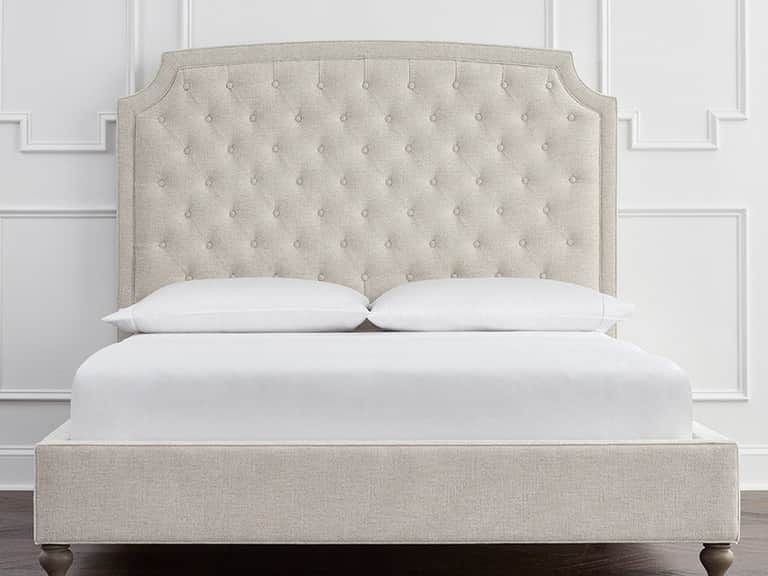
Upholstery, meanwhile, can soften the frame’s outline. A padded headboard might recall the comfort and domesticity associated with older bedrooms while keeping the overall design uncluttered. Its texture becomes part of the composition: linen-like cloth, wool, or a smooth, tightly tailored surface each shifts the room’s tone. Here, restraint is useful. A simple upholstered panel can sit comfortably beside antique bedside tables; elaborate tufting may compete with them.
Visible construction is a design choice
Joinery is usually discussed as a technical matter, but it has an aesthetic life. A mortise-and-tenon joint, a carefully fitted rail, or a bracket concealed inside a corner can express an idea of furniture as something made to work for a long time. Even when a join is not immediately visible, the confidence of the structure can be felt in the way a frame stands and moves.
That does not mean every modern bed should advertise its engineering. Some designs conceal fixings and connections behind smooth surfaces; others make the meeting of parts a visible feature. Either approach can be persuasive when it is deliberate. The question is whether the frame’s appearance gives an honest account of its function. A leg that seems to support the bed, a rail that looks properly connected, and slats spaced to support the intended mattress all contribute to an impression of coherence.
For a period-inspired room, this is often more effective than applied ornament. Carving can certainly belong in such a bedroom, especially when it appears on an authentic antique or a thoughtfully made reproduction. But ornament without structural clarity can make a new object feel like a stage prop. By contrast, a well-made contemporary frame can communicate craft through its proportions, grain and construction, allowing the surrounding room to supply the historical notes.
There is also a practical reason to pay attention to the support system. Platform frames are designed to carry a mattress directly, but requirements vary by mattress and frame. Slat spacing, centre support, weight capacity and the manufacturer’s guidance all deserve attention. A visually convincing bed that does not properly support its mattress is not a successful translation of furniture history; it is simply an attractive problem. Compatibility should be confirmed before a frame is chosen, especially when pairing it with a substantial or specialised mattress.
A contemporary frame can converse with antiques
The most satisfying period-inspired rooms tend to resist the temptation to make everything agree. An antique chest beside a clean-lined platform bed can create a useful tension: one object has accumulated time; the other gives the room a more open, present-day structure. A brass bed inherited from a relative may share space with plain cotton bedding and an unadorned lamp. The effect can feel more intimate than a room in which every piece has been selected to match a single historical mood.
Scale and finish help keep such combinations from appearing accidental. If a dark, carved cabinet is the room’s heaviest object, a lighter bed frame may give it room to breathe. If the bed is made from expressive wood, quieter bedside furniture can prevent a competition of grain. Repeating one detail—perhaps a warm metal tone, a square-edged profile, or a particular wood colour—can connect pieces from different eras without forcing them into a false family resemblance.
Textiles matter because they occupy so much of the bed’s visible area. Crisp white bedding can clarify the outline of a carved or richly coloured frame. A woven coverlet or muted stripe may nod to domestic histories without turning the bed into a historical illustration. Curtains, rugs and lighting can introduce softness and age in smaller measures. The aim is not to erase the difference between old and new, but to make that difference feel considered.
Two examples of the translation
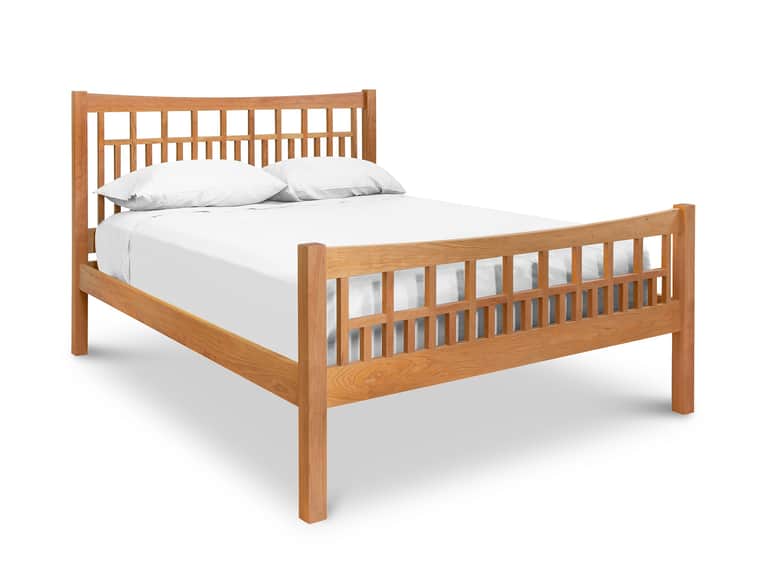
The Glastenbury Platform Bed draws on Arts and Crafts character through its mission-style legs and headboard and footboard, while retaining the direct utility of a platform frame. Made in solid wood and offered in cherry, maple or walnut, it places its emphasis on material and construction rather than elaborate historical ornament. Its restrained silhouette can provide a strong centre for a bedroom with antiques, but it does not require the rest of the room to follow a single period vocabulary.
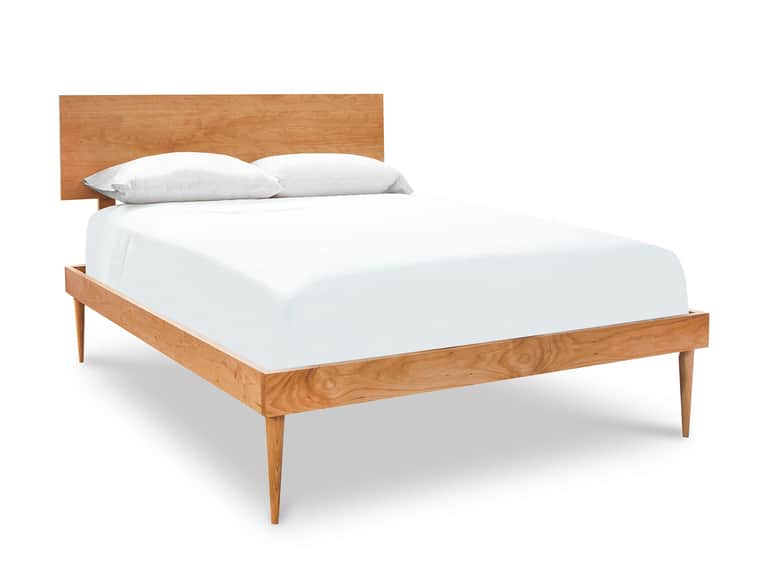
The Larssen Bed takes another route. Its one-piece headboard and slender tapered legs create a quieter outline, with natural hardwood options allowing the grain to remain part of the design. It is a useful example of how a contemporary bed can feel grounded in craft without borrowing the most recognizable features of a Victorian or Edwardian bedstead. The result is less a quotation than a conversation: a familiar seriousness of material, delivered in a simpler form.
Neither example should be treated as a universal solution. The right frame depends on the room’s dimensions, the mattress, the furniture already there and the kind of historical reference that appeals to the occupant. A bed with a strong Arts and Crafts influence may suit a room built around solid wood and honest construction. A more reduced frame may be better when an antique chest or metal bedstead is already the visual centre.
Choose for the room you actually have
Period furniture can invite fantasy. It asks us to imagine a more spacious house, a more formal household, perhaps even a different pace of life. But a useful bedroom has to accommodate the present: storage, circulation, reading, changing sheets, getting to the window. A frame should not make these ordinary tasks feel like interruptions to a design concept.
Begin with measurements. Account for the bed’s external dimensions, not just the mattress size, and check the clearance around doors, drawers and bedside tables. Consider whether a footboard will obstruct a walkway or whether a low frame will make under-bed cleaning difficult. Look closely at the support structure and confirm that the mattress is suitable for the frame. These decisions have little glamour, but they determine whether the bed belongs in the room rather than merely fitting through the door.
Then consider what “period-inspired” means to you. It may refer to the warmth of aged wood, the geometry of Arts and Crafts furniture, the fine metalwork of an antique brass bed, or simply a preference for objects that seem built rather than disposable. Naming the quality you want is more useful than searching for a broad style label. It helps distinguish the features worth carrying forward from the ones that would make the room feel like a set.
The value of an unfinished conversation
A modern bedroom need not resolve every historical reference. Indeed, a little uncertainty is often its charm. A sturdy bed with a simple profile can sit beside a worn antique table; a contemporary platform can give an inherited brass object a new context. The room becomes interesting not because it has arrived at a single, perfect period, but because its objects seem to have met across time.
Platform frames are well suited to that kind of arrangement. They offer a practical foundation and a flexible outline, while leaving room for the expressive qualities associated with older furniture: wood with visible grain, metal with a warm surface, careful joinery, and proportions that give an object dignity. They can make the bedroom feel historically attentive without requiring it to pretend that the present has not happened.
That may be the most useful lesson period furniture offers. Its enduring appeal lies not in the obligation to reproduce every flourish, but in the attention it gives to material, use and form. A well-chosen platform bed carries those concerns into a contemporary room. It does not ask the occupant to sleep in another century. It simply lets the past remain in the room, comfortably, as one of its voices.